
Manchester Storm sold 9,528 tickets for a pre-season game against Sheffield Steelers this month, a figure that would set a record for a fixture between two Elite League sides. That’s a genuinely significant number for British hockey. Try finding a betting market on it at a major sportsbook and you’ll find nothing at all, because the books that dominate advertising spend have decided the EIHL isn’t worth a trader’s afternoon.
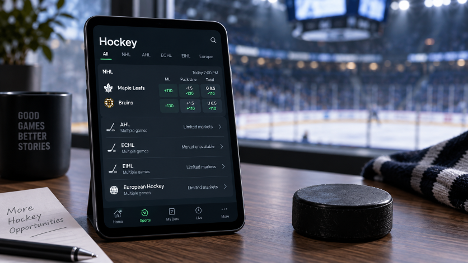
That gap between what hockey fans actually follow and what sportsbooks actually price is wider in this sport than almost any other, and it shapes where serious hockey bettors end up.
Why Does Hockey Get Such Thin Market Coverage?
Because sportsbook trading resources follow handle, and handle follows the leagues with the biggest broadcast footprints. An NFL Sunday gets dozens of traders and hundreds of markets per game. The NHL gets solid coverage on moneylines, puck lines, and totals, decent props on the marquee matchups, and progressively less as you move down the card. Below the NHL, coverage collapses fast.
The AHL gets sporadic pricing. The ECHL rarely gets any at all, despite a full slate of games and a genuine following around clubs like the Wichita Thunder and the Trois-Rivières Lions. European leagues fare a little better in their home markets, but a bettor in North America looking to price a DEL2 fixture or a Champions Hockey League tie is usually out of luck at a mainstream book. The EIHL, which just drew a near-sellout crowd at the AO Arena, sits in that same category.

This isn’t a conspiracy. It’s a resourcing decision, and it’s entirely rational from the operator’s side. It just leaves a specific kind of bettor without anywhere to bet.
Where Do Hockey Bettors Go When the Big Books Ignore Their League?
Increasingly, to a different tier of sportsbook entirely: offshore and crypto-native operators that built their market coverage around breadth rather than around whatever the domestic television deal prioritizes. These platforms often price leagues the major books skip, partly because their trading models are built for a global customer base rather than one national market.
Coverage is the appeal, and there’s a genuine trade-off attached that’s worth being clear about. What you gain in market depth, you lose in regulatory protection. A UK-licensed or Ontario-licensed book gives you a dispute path if something goes wrong. An offshore operator running on a Curaçao or Anjouan licence gives you a considerably weaker one, and a site with no real licence at all gives you essentially nothing beyond hoping the operator behaves.
What Should a Hockey Bettor Actually Check Before Depositing Anywhere?
Market depth first, since that’s the reason you’re looking outside the mainstream books in the first place. A site claiming broad hockey coverage that turns out to price only NHL sides and totals hasn’t solved your problem, it’s just moved it.
Odds quality matters more than most bettors weight it. Thin markets on secondary leagues frequently carry brutal margins, precisely because so few operators price them that nobody’s competition forces the number tighter. If you’re betting an EIHL total, price-check it across two or three books before placing anything, because the spread between them on a market that lightly traded can be enormous.
Withdrawal behavior is the one that actually costs people money. A slow payout is annoying once. A payout stuck in indefinite “review” after a winning run is a different category of problem entirely, and it’s the failure mode that separates a usable operator from an expensive lesson. Anyone evaluating this seriously should be looking at platforms that have been tested with real deposits and real cashout attempts rather than reviewed off a marketing page. CoinBettors runs exactly that kind of testing across dozens of operators, documenting payout speeds, verification triggers, and how books behave once an account stops losing reliably.
Does Getting Limited Work Differently in Hockey?
Somewhat, and it’s worth understanding. Sportsbook risk engines identify sharp accounts by watching for consistent success against the closing number, and they act fastest in the markets where their own pricing is weakest. Since hockey pricing outside the NHL is genuinely thin, a bettor with real expertise in a specific league is disproportionately likely to trigger a limit cut, because the book knows its own number on a Coventry Blaze game is softer than its number on a Maple Leafs moneyline.
The unfortunate implication is that the deeper your specific knowledge, the faster you get squeezed. A punter with genuine insight into ECHL roster movement, the kind that comes from actually following signings like Tyler Rollwagen joining Tahoe or Ethan Scardina landing in Wichita, is exactly the customer a book wants to stake at a fiver rather than at meaningful money.
What Does This Mean for the Sport Commercially?
Something worth watching, given how quickly hockey’s broadcast and commercial landscape is shifting. Rogers and Prime Video signing a twelve-year sublicensing deal, Prime Video taking exclusive local streaming rights in six NHL markets, the NHL partnering with FC Bayern to build German audience, all of that expands the sport’s reach into territories where the local sportsbook coverage will eventually have to follow.

Broadcast reach and betting market depth tend to move together, with a lag. The leagues currently underserved by sportsbooks are underserved partly because their audience numbers didn’t previously justify the trading cost. Numbers like 9,528 at the AO Arena are the kind of thing that eventually changes that calculation, though probably not before the bettors who care about those leagues have already gone looking elsewhere.
