
The Undisputed Top-5
Money in the NHL doesn’t behave evenly; it never has. Some teams grind just to stay competitive. Others operate with built-in advantages that don’t really go away. Bigger markets, deeper history and fans who keep paying no matter what the standings say in March. Their finances don’t always measure the wealthiest NHL franchises.
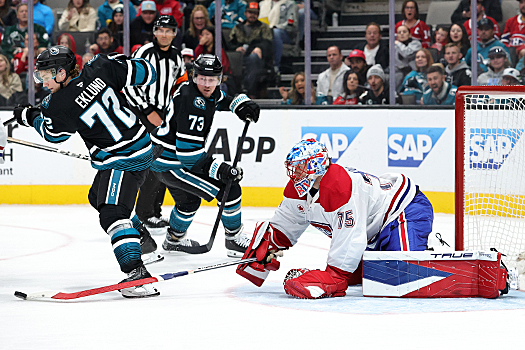
Canadiens goalie Jakub Dobes attempts to poke the puck away from William Eklund (72) – Photo by Jack Lima
Toronto Maple Leafs
You’d think decades without a Stanley Cup would cool things down, but it hasn’t. Toronto is still the most valuable NHL team. Still sells out. Still dominates media coverage across Canada. It’s not even close in terms of attention.
Here’s the interesting part. Performance barely touches their value. The last Cup came in 1967. That’s not a drought anymore, that’s a different era entirely. And yet, tickets are among the most expensive in hockey. Corporate money keeps flowing. Merchandise moves globally.

This is what happens when you combine one of the oldest NHL franchises with a market that treats hockey like oxygen. Winning becomes optional. Revenue doesn’t.
New York Rangers
The Rangers don’t need to chase relevance; they’re in New York. Madison Square Garden prints money in ways smaller markets can’t replicate. Sponsorships, premium seating, media deals—it stacks quickly. Even a mediocre season doesn’t dent the business side much, which is why the Rangers are still one of the most popular NHL teams around.
They’ve won one Stanley Cup since 1940. And still sit near the top of the most valuable NHL teams every year. The brand carries itself; the location does the rest.
Montreal Canadiens
Montreal feels different from the others on this list. 24 Stanley Cups – that number alone carries weight. Generations of fans passed it down like something permanent.
Even when the Canadiens struggle—and they have, recently—the value doesn’t collapse. Because it’s not tied only to current performance. It’s tied to identity.
They’re one of the oldest NHL franchises, dating back to 1909. That matters in hockey more than it does in most sports. Tradition sells. And in Montreal, tradition is the product.
Chicago Blackhawks
Chicago wasn’t always sitting this high. Then came the run. Three Stanley Cups in six seasons (2010, 2013, 2015). That stretch didn’t just add banners—it rebuilt the entire business side of the franchise.
Attendance surged. National relevance followed. Suddenly, the Blackhawks weren’t just another Original Six team; they were current, visible, and marketable again.
Big city helps, obviously. Chicago supports major sports across the board. But without those championships, the value doesn’t spike the same way.
This is the clearest case on the list where winning directly reshaped long-term financial standing.
Boston Bruins
The Bruins are consistent; there are no major fluctuations. This stability allows for the rest of their operations to remain stable. Ticket sales don’t dip, the media still shows up and sponsors stay put. That part doesn’t really wobble.
They’ve been around since 1924, which puts them deep in the foundation years of the NHL. Not loud, not constantly in your face, just established, steady and hard to move, even without making the most noise in the room. Not always the most talked about, but they’re always there.
And over time, that reliability turns into value.
What Actually Separates These Teams
It’s not just money; it’s insulation. All five teams share a few traits:
- Large markets or deeply embedded hockey cultures
- Long histories tied to the league’s foundation
- Fan bases that don’t disappear during bad seasons
Toronto proves you can struggle competitively and still lead financially. Chicago shows how winning can accelerate everything. Montreal sits somewhere in between—history doing most of the work.
Smaller-market teams don’t get that margin for error. They need results just to keep pace.
It’s All About Business
At the top level, these franchises are businesses first, teams second. Winning helps; Chicago is proof. But it’s not required. Toronto exists in its own category entirely.
What actually matters is where a team sits, how long it’s been rooted there, and how much the fanbase has poured into it, money, time, all of it.

That’s why the biggest draws in the NHL usually line up with the most valuable franchises. Not a coincidence, more like a pattern that keeps repeating once you know where to look.
And if you follow betting markets or just track league trends, those same teams stay front and center year after year. You can dig into odds and matchups by BetUS and you’ll notice the same pattern.
