
Hockey trains you to expect speed. Not just on the ice, either. If you watch enough NHL games, your brain gets used to hard transitions, quick reads, and momentum swings that happen in a blink. Just ask someone who doesn’t follow it to try and track the puck.
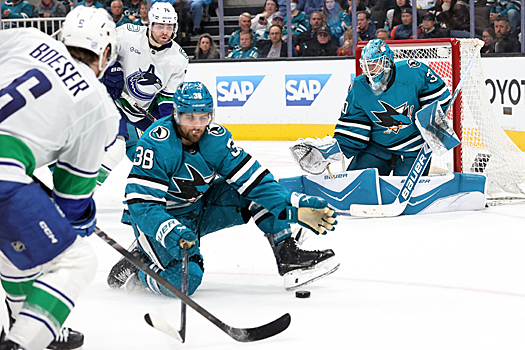
Sharks Mario Ferraro (3) reaches to block a shot from Brock Besser (6) – Photo by Jack Lima
A clean zone exit turns into an odd-man rush. A harmless shift suddenly becomes a power play. A game that felt flat five minutes ago is suddenly alive because one forecheck landed at exactly the right time. That rhythm changes what fans expect everywhere else.
In 2026, the NHL experience is not confined to the broadcast window. The league’s EDGE ecosystem now gives fans deeper player and puck tracking, including zone maps, team comparisons, and daily visualizations built from the NHL’s tracking data. The official NHL app has also leaned harder into reworked stats and live updates, making second-screen hockey feel more normal than niche. So when hockey fans move from the game itself into digital entertainment, they do not leave that tempo behind. They bring it with them.

Hockey fans do not really “clock out” anymore
The old version of fandom was simpler. You watched the game, maybe argued about a missed call or a bad change, and moved on. That is not really how it works now. Modern hockey fans stay engaged after the final horn. They check advanced stats, rewatch key sequences, look at player tracking, and jump into simulations,interactive gaming, or other data-rich formats. Pro Hockey News has already pointed out that digital tools, league apps, and interactive platforms have changed how fans engage with the sport beyond the rink itself.
That shift matters because it means the fan journey is no longer a straight line from puck drop to postgame. It is more like a loop. Broadcast, stats, clips, simulation, discussion, then back again. And once you are used to that loop, sluggish digital experiences start to feel wrong almost immediately.
The pace of the sport becomes the pace of the software
This is where hockey differs from slower sports in a very practical way. A fan used to baseball or golf may tolerate a little delay, a little drift, a little extra breathing room. Hockey fans are calibrated differently.
They are used to:
- fast line changes
- instant pressure shifts
- little room for dead air
- sequences where one second matters
This expectation of speed isn’t limited to the NHL app; it dictates how these fans choose everything from their streaming services to their preferred online gaming platforms. So when they open a digital product, they expect some version of that same responsiveness. Not because they are consciously asking for “better UX,” but because anything slow feels out of step with the sport they love.
That is true in simulations and game-day tools, but it also carries into adjacent formats. The digital experiences that tend to resonate with hockey fans are the ones that feel clean, sharp, and immediate. Slow loading, muddy visuals, or delayed response create the same kind of frustration as a blown line change in the neutral zone. It does not just feel annoying. It feels structurally wrong.
Why pressure-based entertainment feels familiar
There is another reason certain digital experiences land with hockey audiences: they understand tension. A good hockey game is full of built-in pressure valves. Think about the way a crowd sounds during a late power play. The whole rink tightens. Every pass feels heavier. One blocked shot releases the room. One clean look from the slot changes everything.
That tension-and-release pattern is one of the core pleasures of hockey as a spectator sport. It is also why pressure-based digital formats can feel oddly familiar to hockey fans even when they are doing something very different.
The connection is not literal. A digital game is not the same as a 5-on-3 in the third period. But the emotional pacing can rhyme with it. Build pressure. Hold it. Release it fast. Repeat. That is a very hockey way of experiencing entertainment. We recently made a similar point from another angle, noting that the league’s digital direction is increasingly pushing fan experiences toward sharper, more real-time forms of engagement that line up with how modern audiences actually process the game.
From spectator to participant
At the rink, or on the sofa, the fan is mostly reacting. You read the play, anticipate danger, and feel the game as it unfolds, but you are still a passenger. Digital spaces shift that balance. Suddenly the fan is no longer only reacting to pressure. They are making decisions inside it.
That is one reason modern hockey audiences move so comfortably between viewing and interactive formats. The line between spectator and participant has blurred. Real-time stats, live app features, tracking overlays, and increasingly responsive second-screen tools all push in that direction. Even officials are now wearing connected devices to receive haptic alerts and game-clock information in real time, which says something about how deeply tech and responsiveness have moved into the sport’s culture.
This appetite for fast, responsive interaction doesn’t simply switch off when the final buzzer sounds. Because hockey fans are conditioned to process information in high-pressure bursts, they often seek out digital formats that mirror that same ‘rapid-response’ loop during their downtime.
We see this clearly in the crossover between sports analytics and interactive entertainment. For a fan used to the instant feedback of a puck-tracking overlay or a real-time stat update, the transition into playing online casino games feels remarkably intuitive. The mechanics of a high-speed slot or a live dealer table rely on the same ‘tension-and-release’ pacing that defines a power play. It isn’t just about the game itself; it’s about a shared digital language where speed, visual clarity, and immediate outcomes are the baseline expectations for any platform competing for a modern fan’s attention. Fans expect pro-league polish now
There is a broader standard issue here too. Hockey fans are used to cleaner visuals than they were a few years ago. EDGE has changed how tracking data is presented, the app experience has become more stats-heavy, and streaming distribution is increasingly central to how people follow the league across devices.That raises expectations.
A digital product aimed at this audience cannot feel minor league. It has to be visually clear, quick to react, and built with some respect for the fan’s tolerance for pace. If it feels clunky, it loses credibility fast. Hockey fans may not always describe that in technical language, but they know it when they feel it.
And maybe that is the simplest way to put it. Hockey is not just a sport fans watch. It becomes a kind of tempo they carry with them. The most effective digital experiences understand that. They do not just look vaguely hockey-themed. They move like the game moves. Fast, sharp, and without asking the fan to wait around for the play to catch up.
