
Betting on ice hockey has become widespread in both Canada and the United States. Bettors are attracted to the league because of its rapid and physically demanding matches along with the even distribution of strength in the competition. With the exception of higher scoring sports, matches in the NHL are low scoring and are decided by 1 goal. Defenses can be weak at the ends of the game, as well as in overtimes, and this is where scoring opportunities arise. This creates variance, and looking beyond the box score is where the analysis lies. Effective NHL betting tips are concerned with puck possession, the quality of shots taken, goaltending efficiency, and even the dynamics of the schedule, in contrast to a simple assessment of wins or losses.

Travis Sanheim #6 of the Philadelphia Flyers defends his goalie Dan Vladar #80 against Corey Perry #10 of the Los Angeles Kings Photo by Jack Smart
NHL Betting Basics
NHL betting is based on a long regular season and a large set of data points. With over eighty games each season, hockey betting trends such as home ice advantage, division rival familiarity, and travel fatigue show as more than simply anecdotal. In addition, scoring is low in hockey relative to other professional sports, and each goal has a disproportionate impact on moneylines and the over/under. When wagering on these markets, choosing a reputable online crypto casino ensures you have access to competitive odds and instant payouts.

It is also key to know how the sportsbooks set the prices on the various markets. Moneylines show the implied probability of winning the game, puck lines factor in goals scored (and thus the winning-margins goal differential), and game totals depend on game pace/defensive scheme/goaltending. Strength of each team, as well as betting volume and the time of the wagers, set the lines. Odds moving due to the betting ‘public’ as opposed to the ‘smart’ money can provide detail toward further decision making.
Ice Hockey Betting Tips
In hockey betting the importance of patience and situational awareness cannot be overstated. There is much more randomness in hockey compared to other sports. This is due to the high number of deflections in the game, overtime policies, and other unforeseen factors. Because of this, selective betting usually outperforms high volume betting.
Confirming the starting goalies before placing a bet is crucial. There can be significant shifts in totals and moneyline values when a primary starter is substituted out for a backup. Also, keep an eye on back to back games and extended road trips. If defensive fatigue is an issue, the flow of the game and the defense could lead to more goals being scored. Objective metrics such as expected goals and shot quality should be at the core of any betting tips NHLl, as they allow you to ignore deceptive winning or losing streaks.
NHL Betting Strategies
NHL betting focuses on structure and risk management over diversification and spreading the risk. Experienced bettors have more knowledge for one market like puck lines, allowing them to become more familiar with pricing and how different variables affect the outcome. Having confirmed players and starting goalie matchups will assist in deciding how to invest out of the uncertainty.
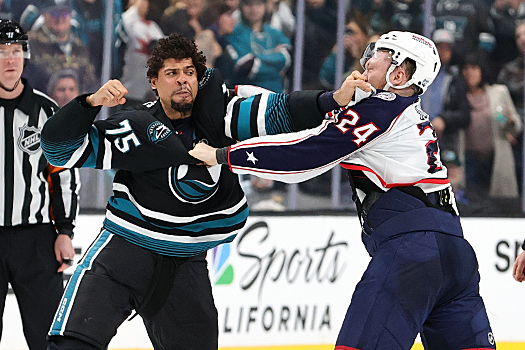
Sharks forward Ryan Reaves (75) gets ready to throw a punch at Mathieu Olivier (24) – Photo by Jack Lima
More NHL betting strategies have started to develop with the utilization of advanced metrics. Corsi and Fenwick help with possession and territory control, while xG focuses on quality of shots taken (and not the quantity of them). If some teams consistently underperform and have lower score goals (but statistically have more expected goals), they are likely to be an undervalued bet. On the other end of the spectrum, teams that overperform are likely to regress back to the mean YTD.
Due to OTs and shootouts it is more critical to consider stake amounts to preserve your bankroll, as these introduce extra variables and more uncertainty to the game.
Hockey Betting Strategy Overview
An excellent betting strategy on hockey takes into account situational context along with the structural identity of the teams involved. For instance, some teams utilize aggressive forechecking and a high volume of shots, resulting in increased scoring opportunities. On the other hand, some teams use a more structured system of defense that minimizes high-danger opportunities, leading to a more effective overall defense and supportive, defensively lower-scoring outputs.
In terms of NHL betting predictions, the overall efficiency of the special teams can greatly influence the outcome of a certain match. For example, if a team has a good power play and the opposing team has a weak penalty kill, the prediction of the number of goals that can be scored in that match can be shifted significantly. This is especially important in close divisional matchups. Box scores or other stat sites don’t give the full picture of a hockey game, as other factors like defensive zone play, speed of transition play, and even the neutral zone processes can dictate the flow of a hockey game.
Teams also have to be taken into account due to the nature of the hockey schedule. Streaks of long road trips can make teams less defensively alert. This is the kind of betting insight that can often be overlooked, yet is extremely useful, allowing a bettor to find value that exists beneath a simpler narrative.
Line Value and Probability Assessment
Ice hockey sports betting is a field in which understanding value and betting opportunities is more important than simply calling winners. Every betting line can be broken down into an implied probability. The question isn’t can a team win, it is whether or not the odds given are fair. When a bettor’s calculated probability is greater than the implied probability, that is a positive expected value situation.
As an example, +150 odds indicate a 40% implied probability. If a team’s probability of winning is estimated to be 46-48% through some analytical evaluation (goaltending matchups, expected goals, schedule, and so on) betting on that team will be a long-term value bet regardless of the outcome. The dominant focus on value-oriented betting is what shifts a bettor’s focus from outcome to process. In the long run, value-driven betting is more successful than betting based on instinct.
Another important consideration is closing line value (CLV). If a bettor is able to consistently get better odds than the final line, they are likely to be betting in line with the more accurate set of expectations.
Popular NHL Betting Markets
In the NHL, bettors can choose from several core markets that reflect different risk profiles. The moneyline offers a straightforward prediction of the winner, while the puck line incorporates goal differential and therefore greater volatility. Total markets depend heavily on pace, goaltending, and special teams performance. Team totals isolate one side’s offensive expectation, which can be useful in mismatched defensive pairings.
Choosing the appropriate market often proves more important than predicting the exact final score. Certain matchups may offer stronger value in totals due to contrasting play styles, while others may favor regulation outcomes depending on defensive structure and overtime tendencies.
Analyzing NHL Teams and Matchups
In order to analyze an NHL matchup correctly, you have to look beyond the last few games played. Metrics such as shots on goal, expected goals, and goals from high danger scoring chances are differentials and usually are what show trends and tendencies that the final scores do not. A team generating consistent offensive pressure but suffering from temporary finishing inefficiency may present betting value once regression stabilizes outcomes.
Goaltender performance remains central. Advanced measures such as goals saved above expected provide deeper insight than traditional save percentage alone. Road splits, workload distribution, and performance in back-to-back situations can materially influence probability.
Travel schedules and rest days also shape outcomes, particularly during compressed segments of the season. Fatigue often manifests defensively, increasing turnover rates and late-game breakdowns that impact both sides and totals. Applying these advanced metrics to your strategy is the most effective way to evaluate the latest NHL betting tips today and maintain a competitive edge over the long term.
| Analysis Factor | Why It Matters | How Bettors Use It |
| Goalie Form | Strong impact on outcomes | Adjust moneyline risk |
| Shot Metrics | Indicates true performance | Identify undervalued teams |
| Home Ice | Influences pace and confidence | Favor strong home sides |
| Schedule Load | Fatigue affects consistency | Avoid tired teams |
Common NHL Betting Mistakes
A lack of knowledge and the tendency to focus on the short-term lead to common mistakes in NHL betting. Betting on too many games in one slate, betting when there is not goalie confirmation, and overestimating the significance of recent blowouts are good examples. Way too many emotionally driven reactions to late goals and overtime losses lead to chase betting, and that definitely increases the amount of variance to which you are exposed.
Betting mistakes can be reduced with a solid betting strategy, a guide to determining the size of your stake, and an analysis of your past performance.
Psychological Discipline and Long-Term Consistency
Volatility in hockey is something even the best analytical models cannot predict. Variables like overtime rules, deflected pucks, and bursts of scoring all contribute a randomness that can muddle short-term predictions. For this reason, discipline is a key psychological element of profitable betting in the NHL.
Even the most structured betting models can see variance run against them in the short-term. Not betting on a team because you’ve lost a few times in a row is the kind of mental lapse that will be costly. Trying to replace a negative expectation bet by closing a live bet will almost certainly be a very negative bet. But once you have a well-structured betting model, you will be responding to mental pressure in a structured, predictable way.
When you bet, you are making a decision about the future. Analyzing the future in sport is hard, even professional people in the field get it wrong. Because of this, it’s important to abandon the traditional sports mindset of winning and losing when analyzing betting. There are too many sports bettors who lack the analytical mindset, and that is a profitable opportunity.
Responsible NHL Betting Approach
Informed wagering in the NHL asks that bettors take a long-term position. Weekly staking limits, empirical tracking, and avoidance of emotional betting decisions are the critical factors in sustainable NHL betting. The objective is sustainable engagement rather than guaranteed profit.
The value in tracking results is in extended samples. Isolating short-term variability can create a misleading picture. Advanced analytics, situational awareness, and disciplined risk management are the fundamental tools of consistent and confident wagering.
