
Hockey betting used to rely on box scores, gut feelings, and whatever a broadcaster said during intermission. The bettor who wanted to wager on Connor McDavid recording a point had little more than season averages and recent form to guide the decision. That approach still works for some, but it leaves money on the table.
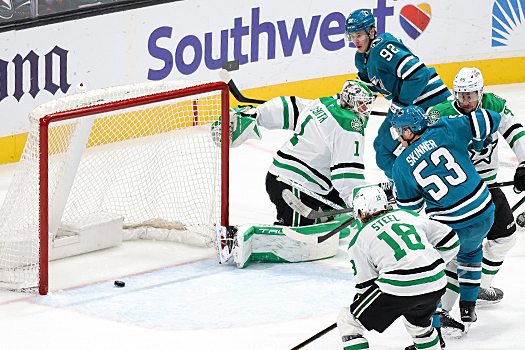
Sharks forward Jeff Skinner (53) scores the Sharks’ second power play goal of the second period past Stars goalie Casey DeSmith Photo credit: Jack.Lima@prohockeynews.com
The NHL now tracks millions of data points through its EDGE system. Skating acceleration, top speed, shot power, shot location, and save types all feed into a database that anyone can access. Bettors who understand these numbers hold an advantage over those who ignore them. Player prop markets have responded accordingly, and the gap between casual bettors and informed ones has widened.
What the NHL EDGE System Provides
The League collects granular information on every player during every game. For skaters, this means precise measurements of how fast they move, how hard they shoot, and where they tend to release the puck. For goalies, it means tracking save types and positioning.

The 2025-26 season brings further updates. Zone maps and zone time charts have been redesigned. A new stat called Zone Starts Percentage now appears for skaters, giving bettors context on how coaches deploy players. A forward who starts most shifts in the offensive zone will accumulate counting stats differently than one used primarily in defensive situations. The League has also added 5-on-5 save percentage for goalies, which filters out special teams noise and allows for more accurate comparisons between netminders.
These stats matter for prop bettors because they reveal information that raw totals obscure. A player with 20 shots on goal over 5 games looks productive until you learn that 18 of those shots came from low-danger areas with minimal scoring probability.
Reducing Costs While Betting on NHL Props
Advanced analytics have made prop betting more accessible, but the volume of wagers can add up quickly when you are placing bets on shots on goal, anytime goal scorer, and points markets across multiple games. Bettors who track Corsi and xG data often find themselves betting more frequently as they identify edges in the numbers.
Loyalty programs, deposit matches, and first-bet offers from sportsbooks help offset bankroll depletion over a long season. Use sportsbook bonus codes to save money when signing up, and compare reload promotions across platforms. Tracking these offers alongside your betting activity keeps costs manageable as you test prop strategies built on NHL EDGE data.
The Metrics That Matter for Prop Bets
Several statistics have become standard tools for evaluating player props. Expected goals, or xG, assigns a probability to each shot based on location, angle, and shot type. A player generating high xG numbers but scoring below expectation may present value on anytime goal scorer markets.
Corsi measures shot attempts, including those that miss the net or get blocked. A player with strong Corsi numbers is involved in offensive play, and that involvement tends to produce counting stats over time. High-danger chance percentage tells you how often a player creates or allows quality scoring opportunities. PDO combines shooting percentage and save percentage while a player is on the ice. It tends to regress toward 100 over time, so extreme PDO numbers can signal incoming corrections.
When xG, Corsi, high-danger chance percentage, and PDO all point in the same direction for a given player, bettors have likely found a high-probability opportunity. The alignment of multiple indicators reduces the risk of noise affecting the outcome.
How Simulation Models Process the Data
Betting platforms run thousands of simulations before setting lines on player props. Some models run 10,000 game simulations to identify where value exists on anytime goal scorer, shots on goal, and points markets. These simulations incorporate the metrics described above, along with additional variables.
Fatigue matters in hockey. An 82-game season with travel across 4 time zones wears on players, and algorithms now account for this. A team finishing a back-to-back on the road against a rested opponent will show different expected outputs than the same team playing at home after 2 days of rest. Matchups also factor into the calculations. A top-line forward facing a shutdown defensive pair will generate fewer opportunities than one matched against a third pairing.
Tracking Line Movements
Once you understand the underlying metrics, monitoring how lines move becomes useful. Sharp bettors place large wagers based on their own models, and sportsbooks adjust lines in response. Tracking these movements can reveal where informed money is going.
A player prop that opens at over 2.5 shots on goal and moves to over 3.5 before puck drop signals that sharp action came in on the under. Bettors who notice these shifts early can sometimes capture value before the line adjusts. The practice requires attention and quick execution, but the information is available to anyone watching.
Applying Historical Data and Trends
AI-driven models analyze years of historical data to identify patterns. A forward who has recorded a point in 8 of his last 10 games against a particular opponent may carry that trend forward, especially if the underlying metrics support continued production. Real-time updates during games can also inform live betting decisions, though those require faster processing.
The goal is to combine multiple information sources into a coherent view of what a player is likely to produce. Season averages still matter, but they matter more when placed alongside shot quality, ice time, matchup data, and recent form.
Conclusion
NHL player prop betting rewards those who do the homework. The data exists, the models are accessible, and the edge goes to bettors willing to parse the numbers. Zone Starts Percentage, 5-on-5 save percentage, xG, Corsi, and high-danger chance percentage all provide actionable information. Simulation models and line movement tracking add further layers of analysis. The bettor who combines these tools and manages costs through promotional offers will outperform the one relying on instinct alone.
